Is Begampura a Real Place? Understanding Shri Guru Ravidass Ji Maharaj's Vision
RavidassGuru
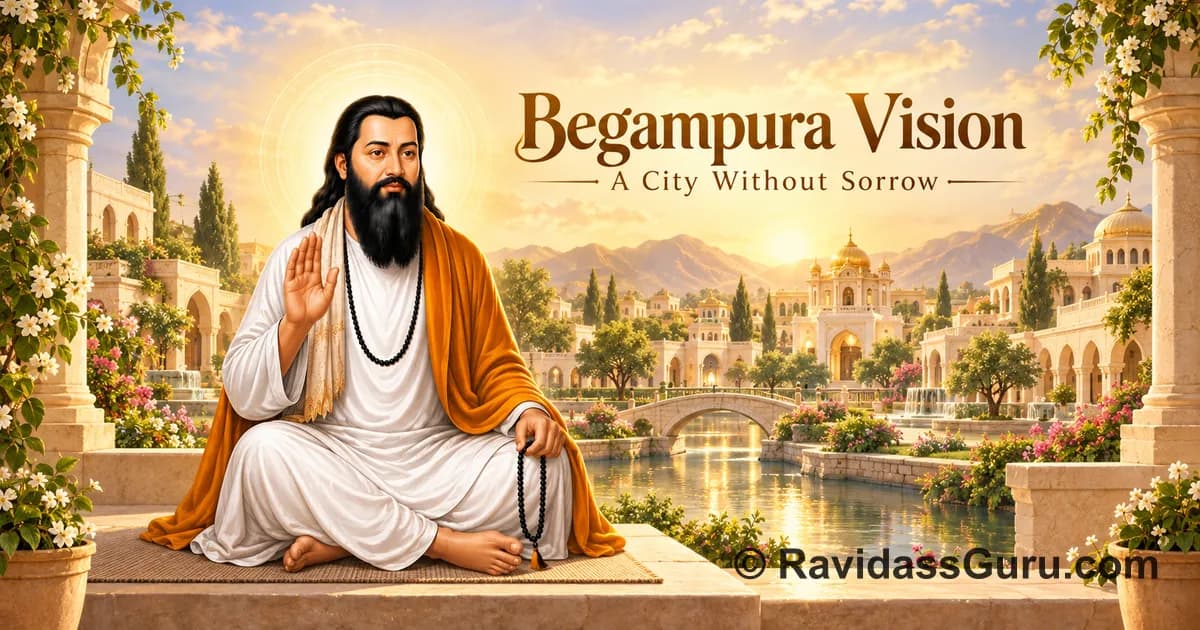
Is Begampura a Real Place? Understanding the Vision of Shri Guru Ravidass Ji Maharaj
Is Begampura a real place?
Anyone reading the words of Shri Guru Ravidass Ji Maharaj for the first time will likely wonder the same thing:
ਬੇਗਮਪੁਰਾ ਸਹਰ ਕੋ ਨਾਉ।
ਦੂਖੁ ਅੰਦੋਹੁ ਨਹੀ ਤਿਹਿ ਠਾਉ।
Begampura Sahar Ko Naau.
Dookh Andoh Nahi Tih Thaau.
“Begampura is the name of that city, where there is no sorrow or suffering.”
The word Begampura describes a city unlike the world people normally experience. In the vision of Shri Guru Ravidass Ji Maharaj, it is free from sorrow and suffering and reflects a society in which people can live with dignity and freedom.
There is no established historical evidence identifying Begampura as a specific physical city that can be located on a modern map. At the same time, describing it as merely fictional misses the deeper meaning of the vision.
In Amritbani Shri Guru Ravidass Ji, Begampura presents a vision of life beyond discrimination, fear and social exclusion. It points toward a society built around equality, dignity, security and freedom.
That is why Begampura remains an important idea for many people today.
What Does Begampura Mean?
The word Begampura is generally understood as “the city without sorrow” or “the place without suffering.”
It is commonly explained through two parts:
- Begam — without sorrow or suffering
- Pura — city or place
The meaning becomes clearer when the word is read alongside the opening lines of the shabad:
ਬੇਗਮਪੁਰਾ ਸਹਰ ਕੋ ਨਾਉ।
ਦੂਖੁ ਅੰਦੋਹੁ ਨਹੀ ਤਿਹਿ ਠਾਉ।
Begampura Sahar Ko Naau.
Dookh Andoh Nahi Tih Thaau.
Begampura is the name of that city; there is no sorrow or suffering there.
The important point is that Shri Guru Ravidass Ji Maharaj is describing more than a geographical location. Begampura represents a different kind of society—one in which people are not defined by fear, humiliation, social exclusion or inherited status.
Did Begampura Actually Exist?
There is no established historical evidence that Begampura was a physical city from the time of Shri Guru Ravidass Ji Maharaj.
No generally accepted geographical location has been identified as the Begampura described in the Amritbani.
For that reason, it would be misleading to point to a modern city and say:
“This is the Begampura of Shri Guru Ravidass Ji Maharaj.”
The Amritbani does not provide the geographical details needed to identify Begampura as a historical city.
Instead, it gives us a description of life in Begampura. This allows the vision to be understood through the conditions it describes rather than through a physical location.
Begampura: A World Without Sorrow
The opening lines establish the defining feature of Begampura: there is no sorrow or suffering there.
The vision becomes more meaningful when we consider the kinds of conditions that can cause suffering in human society.
Begampura can be understood as a society where people are not weighed down by:
- Fear and insecurity
- Discrimination
- Social humiliation
- Injustice
- Oppression
- Exploitation
The emphasis is therefore not simply on creating a beautiful or wealthy city. It is on creating conditions in which human beings can live freely and with dignity.
Begampura and Equality
Equality is one of the central principles expressed through the vision of Begampura.
The teachings associated with Shri Guru Ravidass Ji Maharaj challenge the idea that a person's social position or birth should determine their human worth.
Begampura presents a society in which people are not placed into higher and lower categories simply because of inherited status. Everyone should be able to live with dignity and participate in society without being treated as inferior.
This connects Begampura with the wider teachings associated with:
- Equality
- Human dignity
- Freedom
- Social justice
- Brotherhood
- Rejection of caste discrimination
Begampura therefore gives a social dimension to the principle of human equality.
Begampura and Freedom From Fear
Freedom in Begampura is more than physical freedom.
A person may technically be free while still living in fear of discrimination, oppression, humiliation or insecurity. A truly free society must also allow people to live without constantly fearing how they will be treated.
This is why the vision of Begampura can be connected with freedom from:
- Oppression
- Discrimination
- Social exclusion
- Economic insecurity
- Loss of dignity
Freedom, in this sense, includes the security necessary to live openly and participate in society without fear.
Begampura and Social Justice
Begampura also raises a broader question:
What makes a society just?
A society can become wealthy or technologically advanced while some people remain excluded or face discrimination. Begampura offers another measure of progress—how people are treated and whether they can live with dignity.
A just society does not allow birth or social position to determine who deserves respect.
Seen this way, Begampura can be understood as both a spiritual vision and a social ideal.
It points toward:
Equality instead of hierarchy.
Freedom instead of fear.
Dignity instead of humiliation.
Justice instead of oppression.
Belonging instead of exclusion.
These principles help explain why Begampura continues to have meaning beyond its original historical setting.
Begampura and Caste
The vision of Begampura is particularly significant when considered in relation to caste.
The teachings of Shri Guru Ravidass Ji Maharaj are widely associated with a rejection of caste-based inequality and the idea that birth determines a person's worth.
Begampura reflects this principle through its description of a society where inherited social divisions do not determine people's lives.
The principle is simple:
No person should be treated as inferior because of their birth.
This makes Begampura an important expression of equality and human dignity within the teachings associated with Shri Guru Ravidass Ji Maharaj.
Begampura Is a Vision of a Just Society
Begampura can also be understood as a vision of a just society concerned with the wellbeing and dignity of its people.
The focus is not simply on whether people possess wealth. What matters is whether people are able to live safely, freely and with dignity.
A society inspired by this principle would seek to reduce unnecessary suffering and protect people from discrimination and oppression.
This does not mean that Begampura should be treated as a detailed political system. Rather, it provides a way to think about what makes a society worth living in:
- Can people live safely?
- Are they treated with dignity?
- Are they free from discrimination?
- Are vulnerable people protected?
- Can they participate in society without humiliation?
- Does society reduce unnecessary suffering?
These questions bring the vision into a social context without turning it into a modern political constitution.
Is Begampura a Spiritual Vision?
Yes. Begampura has a deep spiritual dimension.
The vision connects inner freedom with the conditions in which human beings live. Spiritual peace and social justice are not presented as completely separate concerns.
Begampura brings these dimensions together:
Spiritual freedom with social freedom.
Devotion with equality.
Inner peace with a just society.
This makes Begampura more than a description of an ideal city. It expresses a way of understanding human life in which spiritual values also have consequences for how people live together.
Is Begampura Only a Dream?
Begampura can be described as an ideal, but calling it merely a dream can make the idea seem passive.
The vision can also be read as an invitation to consider what should change in society.
If discrimination causes suffering, it should be challenged.
If people live in fear, society should seek greater security.
If people are treated as inferior, their dignity should be recognised.
If people are excluded, society should make room for them.
The ideal may be difficult to achieve completely, but it can still provide a direction for human action. Begampura offers principles for imagining and working toward a better society, rather than simply an escape from the real world.
Begampura and the Ravidassia Religion
Begampura has an important place in the spiritual and social vision associated with the Ravidassia religion.
For many followers of the Ravidassia religion, it represents the kind of society envisioned by Shri Guru Ravidass Ji Maharaj—one in which equality, freedom and human dignity are not limited by caste or social status.
The values commonly associated with this vision include:
- Equality
- Freedom
- Human dignity
- Social justice
- Peace
- Brotherhood
- Rejection of caste discrimination
Begampura therefore continues to be an important expression of the teachings associated with Shri Guru Ravidass Ji Maharaj and the kind of society those teachings point toward.
Begampura and the Vision of a Welfare State
Some modern readers compare the principles of Begampura with the idea of a welfare state, where the wellbeing and dignity of people are important responsibilities of society.
There are areas of comparison, particularly around reducing suffering, protecting vulnerable people and ensuring that people can live with dignity.
However, the comparison has limits.
Begampura should not be presented as a modern political constitution, government programme or detailed model of the welfare state. It belongs to a different historical and spiritual context.
The comparison is useful mainly because it raises questions that remain relevant:
- Does everyone have equal dignity?
- Are vulnerable people protected?
- Are people free from discrimination?
- Can people live without fear?
- Does society reduce unnecessary suffering?
These questions allow the vision of Begampura to be considered alongside modern ideas without turning it into a modern political system.
Can Begampura Exist in the Real World?
If the question is:
“Can we find Begampura on a map?”
There is no established historical evidence for a physical location.
But if the question is:
“Can we build a society based on the principles of Begampura?”
That is a different question.
The principles represented by Begampura can influence how communities think about equality, dignity and the treatment of others.
A society with less discrimination, less fear and less unnecessary suffering would move closer to the values represented by the vision of Shri Guru Ravidass Ji Maharaj.
Begampura can therefore be understood as an ideal that can guide real-world action, even if it is not a physical city that can be located geographically.
Why Is Begampura Still Relevant Today?
The world has changed greatly since the time of Shri Guru Ravidass Ji Maharaj, but many forms of inequality and suffering remain.
People around the world still experience:
- Caste discrimination
- Racism
- Poverty
- Social exclusion
- Economic inequality
- Religious intolerance
- Fear and insecurity
This gives the vision of Begampura continuing relevance.
Its message also encourages us to look beyond material progress. Economic growth and technology can improve people's lives, but they do not automatically create equality or dignity.
A society can be considered truly better when people are also able to live freely, equally and without humiliation.
The Main Message of Begampura
The central message of Begampura can be stated simply:
Create a society where people can live without sorrow, fear, discrimination and oppression.
The vision of Shri Guru Ravidass Ji Maharaj challenges social divisions that place human beings into higher and lower categories.
Its significance lies in bringing together spiritual freedom, human dignity and social equality.
Begampura asks us to consider not only how individuals live, but also what kind of society allows human beings to live with dignity.
So, Is Begampura a Real Place?
There is no established historical evidence that Begampura was a physical city that can be located on a map today.
But Begampura is “real” in another important sense.
In the Amritbani Shri Guru Ravidass Ji, it is presented as a city without sorrow and suffering—a vision of life in which people are not burdened by discrimination, oppression and inherited social inequality.
Its importance lies less in finding a geographical location and more in understanding the society it represents.
Begampura can therefore be understood as a spiritual and social vision: a society where human beings can live with equality, freedom, justice and dignity.
Whether such a society can ever exist perfectly in the physical world is another question. The enduring value of Begampura is that it gives people a direction to think about—and work toward—a world with less suffering and greater human equality.
Read Begampura in Amritbani Shri Guru Ravidass Ji
Explore the complete Begampura shabad in Amritbani Shri Guru Ravidass Ji, including the original Punjabi/Gurmukhi text, transliteration and meaning.
AI-assisted content: This article was created with AI assistance and reviewed and edited by the RavidassGuru.com team for factual accuracy, historical context, clarity and relevance. The RavidassGuru.com team takes editorial responsibility for the published content.